


Coming home: A foreign correspondent turns to America’s division, and unity
How does a reporter who has spent the past quarter century abroad get attuned to the American story again, and to Americans’ stories? Same as anywhere: By respecting all views while probing for their origins. And by treating mutual understanding as humanity’s most unfailingly constructive tool.
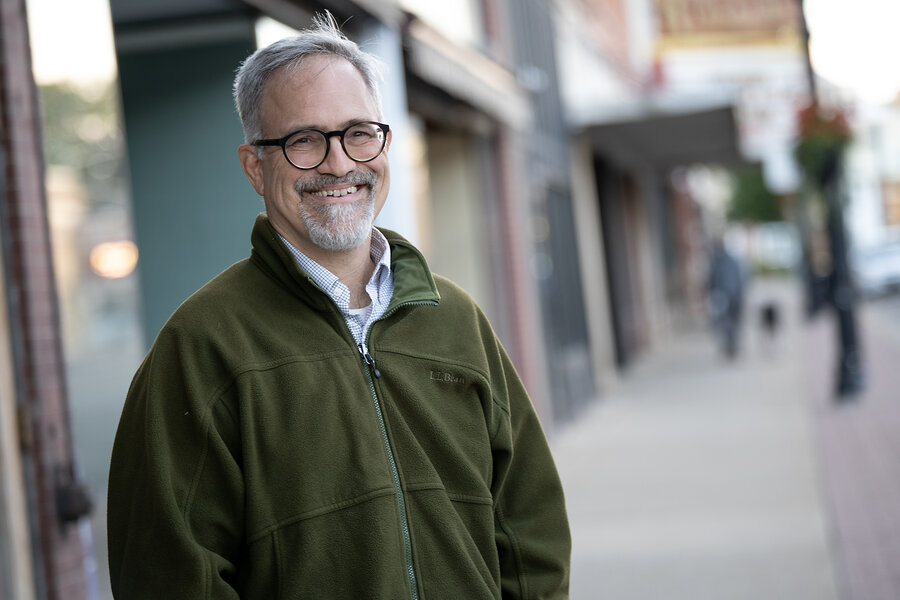
Scott Baldauf has an advantage on his beat. The Monitor’s America correspondent recently returned from 13 years living in Saudi Arabia. He lived outside the United States for about a dozen years before that. That gives Scott, an American, an international journalist’s wide-open perspective.
“Effectively, we have no other choice,” he says, adding his family to the equation. “We’ve lived overseas for so long, we have changed. And the country we left behind ... [is] a very different place than [the one] we left.”
Scott started his stint with a look at his new hometown, Greenbelt, Maryland. There, as elsewhere, he listened to as many voices as possible to get as complete a picture as he could. To hear about solutions as well as problems. To get at motivations. “At the end of the day, you are going to be asking the ‘why’ questions,” he says, “Why do you believe what you believe?”
That sense of empathy and understanding, of fairness, builds trust, Scott says on our “Why We Wrote This” podcast. It’s constructive to bring views together. “Build there, and then find that common ground,” he says, “and ... they know they’re being heard.”
Episode transcript
Clay Collins: “You can’t go home again.” That adage, about the folly of trying to chase nostalgia for the way things were, dates back at least eight and a half decades. And it might be true on some level, but actually you can go back, and if you’re open-hearted and open-minded, you can get a fresh view of home.
What has persisted. What has changed. What ... really matters?
Monitor writer Scott Baldauf recently returned to the US, and to the Monitor, after 13 years in Saudi Arabia, working in a different capacity. In earlier reporting stints at the Monitor, Scott covered education, the American Southwest, India, Pakistan, Afghanistan, and then sub-Saharan Africa as our bureau chief in Johannesburg.
Scott’s based now in the Washington, D.C., area. But as our America correspondent, he has an ear-to-the-ground portfolio that means getting far beyond the Beltway and out into the United States, in order to tell America’s stories. To tell Americans‘ stories.
He started this new stint writing about his new hometown.
[MUSIC]
Collins: This is “Why We Wrote This.” I’m Clay Collins. Scott joins me today. Hey Scott!
Scott Baldauf: Hey, Clay.
Collins: So there’s a school of thought in journalism these days that says an effective strategy for covering the United States as an American reporter is to function as though you’re a foreign correspondent, here on assignment. And you’re actually pretty well positioned to try a little of that. You’ve worked from all over, and you’ve been away and immersed in other cultures. So are you adopting some of that ... intentional-outsider view?
Baldauf: Well, Clay, I’ll be honest with you. My wife and I moved overseas in 2001, we pretty much haven’t come back except for one year, 2012. So effectively we have no other choice. We’ve lived overseas for so long, we have changed. And the country we left behind has changed. It’s a very different place than what we left, 24, 25 years ago.
So looking at things as a foreign correspondent is effectively, I think, what it is to return after such a long time. If you think of the movie “Interstellar,” where Matthew McConaughey went up into space doing whatever he was supposed to be doing, and he comes back, the world he returned to had changed. I kind of feel like that.
Collins: Wow. And so many points of view have hardened.
Finding and presenting perspectives in a way that doesn’t elevate some narratives over others is a central aim of journalism, really. It’s about listening carefully and maintaining something close to intellectual neutrality. And ... I want to get to your Saudi years in a minute. But first, what did you learn in your earlier journalism postings abroad, the ones that I mentioned up top, about doing that kind of listening? About being fair?
Baldauf: Well, it’s something that you practice over time, right? There’s no way to remove oneself entirely. I’m coming with my own perspectives, my own life experiences, and I’m talking to people about their world. Over the course of an interview, you will try to bridge that gap. And you get closer and you get a little closer. So whether that is talking to someone who is, say, in the Taliban. I was interviewing people in the Taliban back in 2001. And for the first time, it was a little unnerving to do. Because you have someone who has a completely, completely different worldview.
But at the end of the day, you are going to be asking the “why” questions: Why do you believe what you believe? And that inevitably gets to a point where they’ll tell you: “I’m doing this because this was what makes sense for me. It makes sense for my family.” And they bring you towards some common ground, where we kind of all have shared wants and needs. We think about how to keep peace in our community. We all have common needs – of food, and safety, and so on.
Coming back to the states where, as you described, things have gotten a lot more polarized. And again, that’s not what I’m used to. It’s a useful skill to ask people what they believe and why, and [then] get at that why. And you often will find that at least you understand the language in which they’re talking of their immediate needs.
Collins: You talked a little there about being yourself and knowing where you stand. I did want to just go briefly into your corporate communications era, Scott. I spent four years in custom contract publishing in the ’90s between two Monitor career stretches. And it’s different, right? I mean a client can be honorable and well intentioned, but ultimately they’re, you know, they’re in a competitive stance and they’re predisposed to messaging, and spin.
So I’m wondering how were you able to shift back out of that gear and get into this heady realm that you just described? And how do you now again see The Christian Science Monitor’s mission as a driver of your approach?
Baldauf: Well, I’ll tell you, I learned a lot in corporate communications. The corporate world is very different from the world of journalism. It’s like a steamship, you know, on a long journey. And it takes a long time for them to make decisions, a long time for them to turn the ship in a certain new direction. And by contrast, you know, with daily journalism, we’re like a speedboat. We’re moving around all the time.
But what guides you with the Monitor is that approach to journalism. We’re absolutely rigorous in our reporting. We want to talk as much as we can to as many voices as possible, make sure that all voices are given a fair hearing. From the person who’s coming from this perspective, they would see it that way – even if that is a bit of a stretch from us, uh, as individuals to think things through in their approach. That is something that is absolutely a necessary part of Monitor journalism. So, it’s coming back. The muscles are getting rebuilt, Clay. And I’m enjoying it.
Collins: Hmm. So you’re basically now “free to roam around the country,” as the airline ad says....
Baldauf: [Laughs.]
Collins: And one of the first places you wrote from was Greenbelt, Maryland, your new home. Uh, it’s a place you had taken the measure of four years ago, and found to have the sense of community that you and your family value. There was even a good Lebanese restaurant! But you found there’d been changes. There’d been job losses. And some of that community glue that you found attractive was loosening. Take us through the process of reporting on that.
Baldauf: The idea of this story came from a conversation with an editor. And she basically said: “So how’s your hometown?” And I started playing out: “Oh, here [are] the wonderful things about the town. And you know, it has a great music scene, great food. You know, it’s a very walkable city. It was designed during the Great Depression for people who needed affordable housing. So it’s a very diverse community.” All the wonderful things.
But then I started to list some of the concerns, which was that almost from the moment we got off the plane, we could feel a changed atmosphere. There’s a lot more worry in the air because there had been the start of layoffs for federal employees. Greenbelt is surrounded by all sorts of federal agencies and government installations. We have NASA’s Goddard Center in Greenbelt itself. Neighboring to us is the USDA’s agricultural research center. Um, even the NSA, the National Security Agency, is close by. And so you have federal employees living in Greenbelt. And when there are layoffs of potentially thousands or tens of thousands of people just in the state of Maryland alone. That’s gonna have an impact. You started seeing “for sale” signs popping up in front of people’s houses, because they already had been laid off, or that they were preparing for what they expected. So, [a] very different mood. And reporting it, it’s odd because I wasn’t really intentionally reporting. I was just noticing. And all of these things that I was noticing suddenly became items in the story. Uh, then it was just a matter of connecting the dots.
Collins: Hmm. And you started to see more to the story than just the loosening of glue. You started to see signs of resilience.
Baldauf: Well, exactly. And this is a typical Monitor perspective. You pause a minute, you breathe in, and you say: “OK, this is not just about the problems. Let’s look for where there are potential solutions.” And I didn’t have to look far. The community itself had responded. It had started to hold sessions to give support to employees who had been laid off. Here are some programs that you can draw on, uh, to help you look for jobs, to get new job training, to shift to something else if you wanna stay within the community, or if you need help in moving out, here’s ... resources for that, too.
It was also clear that the community had itself paused, taken a breath and said: “All right, we can do this.” All the typical fairs and festivals and all the milestones of the year were still going on. The Labor Day parade which – I didn’t know this when we moved in – is a big thing here. There’s a big fairground, midway in the middle of town. And there is a big parade with all, you know, all the politicians come, all the clubs. Um, we didn’t have a Shriners club with all the little miniature cars, which was a little disappointing for me….
Collins: [Laughs.]
Baldauf: But almost everything else that you typically see in a small town was there. You could really just tell that people were loving it, and connecting with each other. And those connections are really where the community shows its health, uh, the way in which people are reaching out, supporting each other … celebrating each other. That started to show through as well.
Collins: That’s storytelling on a really human level. You’ve also written, since you’ve been back, about the controversial use of troops as an aid to civil policing in the US. And, you know, as with so many issues – policy toward the Middle East immigration, these recurring government-shutdown debates – it sometimes seems like there’s just this absence of apparent goodwill, right? From all or some parties, it’s: Take a side, dig in, try to win. You know, there’s that old proverb, uh, Kenyan, I think: “Elephants fight and the grass suffers.”
Talk about the process of getting to these authentic, bottom-up beliefs that inform stories, and how you probe for regular people’s real motivations and convictions, especially when the first thing you hear are maybe parroted talking points.
Baldauf: Yeah this is a really, really good question. And again, I am still learning this process. But I think what you do is you have to build up a sense of trust with the people you’re talking to. If you come out charging, and asking the really tough, contentious questions, um, then people will lock in and they will just spit out the angriest thing that they heard most recently on their favorite news channel.
So what you have to do is just start with that sense of empathy and understanding, hearing where they’re coming from, what their concerns are, what’s their lived experience. Build there, and then find that common ground where you can see each other’s point of view and so that they know they’re being heard.
And then, then, you can get to these tougher things, these tougher questions. I think that often leads to more constructive conversations where people are more willing to hear another point of view. I’m hoping that I see more of that happening in my reporting outside of Washington D.C. Um, obviously D.C. appears to be very much locked into this polarized environment. But I have a feeling that people in what we will call the real world have to live with each other, have to meet the same challenges together. And I think that’s getting back to the United States that I remember from a little ways back.
Collins: It is early days for you on this new beat, obviously, but how does your early reporting this time around have you feeling about your new/old homeland, and about where it goes from here?
Baldauf: When I told my friends back home in Saudi Arabia, uh, what I would be doing. They, they really were worried about my state of mind, my mental health. “Why are you going back to the United States? You know, it’s so lovely here.” And it, I told them, look, I would rather be back in the United States, and seeing up-front what’s happening here, and possibly doing some good, uh, something constructive by reporting on it, the thing that I know how to do. I’d rather do that than to feel hopeless and helpless at home somewhere.
And so this new beat, if nothing else, it’s giving me a chance to see things up close. Those troops that are walking around in the city of Washington, D.C., which is such a shock to the system. But I’d rather see it. And I’d rather talk to people about: What is the next step forward?
I’ll be doing that when I go out. I will have a chance to sit with people and hear how they’re solving their own problems. And to me, when people are sitting down and solving problems, that gives me that sense of hope.
Collins: That’s great. Well, thank you Scott. Really looking forward to your continued constructive work. And again, welcome back to the Monitor. We’ll want to check in again with you for sure.
Baldauf: Thank you.
[MUSIC]
Collins: And thanks to our listeners. You can find show notes with links to the stories we just discussed at CSMonitor.com/WhyWeWroteThis. This episode was hosted by me, Clay Collins, and produced by Jingnan Peng. Mackenzie Farkus is also a producer on the show. Our sound engineer was Alyssa Britton. Original music is by Noel Flatt. Produced by The Christian Science Monitor. Copyright 2025.