



2025
September
04
Thursday

Monitor Daily Podcast

September 04, 2025
Loading the player...

“Beijing,” writes our bureau chief Ann Scott Tyson today, “is taking advantage of uncertainty generated by the Trump administration to pitch itself as the more dependable, capable global superpower.” China isn’t just seeking to supplant America, but to reshape the international order. Its allies in that effort? Russia, India, and North Korea.

Back in the United States, meanwhile, President Donald Trump is calling for a new order in American cities, citing high crime rates. We look at what the continued deployment of National Guard troops in D.C. means for democracy and domestic law enforcement


You've read of free articles. Subscribe to continue.

News briefs

Harvard won a major victory Wednesday as a federal judge struck down $2.6 billion in research funding cuts imposed by the Trump administration. Judge Allison Burroughs wrote that officials invoked antisemitism as a pretext to punish the university after it resisted government demands to change campus policies. The ruling described the freeze as an attack on free speech and academic freedom. The White House said it will appeal, calling Ms. Burroughs biased. – Staff

Florida moved to eliminate all childhood vaccine mandates, expanding Republican Gov. Ron DeSantis’ efforts to curb requirements dating back to the COVID-19 pandemic. Some officials have said current vaccine mandates infringe on parental rights, while critics called the move dangerous. Separately, the Democratic governors of Washington, Oregon, and California announced an alliance to safeguard health policies. – The Associated Press

India is cutting local taxes on a range of consumer goods, from small cars to appliances, in response to U.S. tariffs. The move is part of Prime Minister Narendra Modi’s strategy to insulate the economy. The tariffs, doubled to 50% by President Trump last month over India’s purchase of Russian oil, are expected to hit an estimated $48.2 billion worth of exports and have strained ties between the world’s two largest democracies. – AP

Iran expanded its uranium stockpile to near weapons-grade levels before Israel’s attack in June, according to a confidential U.N. nuclear watchdog report. As of June 13, Iran held 972 pounds of uranium enriched up to 60%, up 71 pounds since May. The report added that Iran and the International Atomic Energy Agency have not reached an agreement on resuming inspections at sites bombed in June. – AP

Newsmax filed an antitrust lawsuit against Fox News, accusing the rival network of using intimidation and exclusionary tactics to stifle competition. The suit alleges Fox blocked distributors from carrying Newsmax, discouraged guests from appearing, and hired private investigators to probe executives. Fox rejected the claims, saying Newsmax is trying to “sue their way out of their own competitive failures.” – AP

Bees hold clues for making artificial intelligence more efficient, new research shows. The insects use their own flight movements to sharpen brain signals and recognize patterns with remarkable accuracy. Scientists at the University of Sheffield in England replicated the effect in a digital model of a bee’s brain, pointing to new ways of building machines that learn more effectively with less computing power. – Staff


Today’s stories

And why we wrote them

Shen Hong/Xinhua/AP
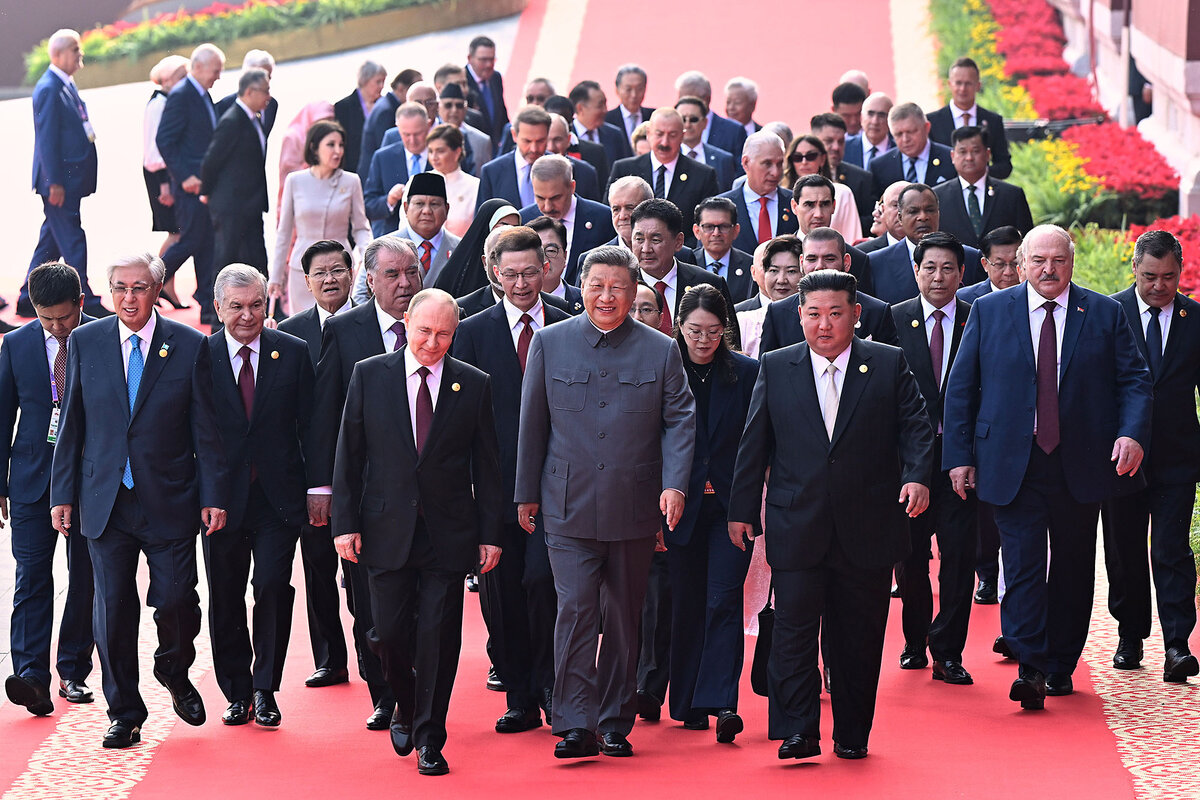
Chinese leader Xi Jinping (center) and foreign leaders, including Russia President Vladimir Putin (center left) and North Korean leader Kim Jong Un (center right), walk to Tiananmen Rostrum ahead of a ceremony to commemorate the 80th anniversary of Japan's World War II surrender, in Beijing, Sept. 3, 2025.

Vladimir Putin and other world leaders alienated by the West gathered in China this week – first for an economic summit in Tianjin and then a military parade in Beijing. The meetings offer a glimpse of what Chinese leader Xi Jinping’s new world order might look like.

Jose Luis Gonzalez/Reuters
Members of the National Guard carry firearms while patrolling the National Mall in Washington, following an order from President Donald Trump to assist in crime prevention in the capital, Aug. 26, 2025.

Americans have long rejected the idea of armed troops patrolling city streets, absent a security crisis. But President Donald Trump’s ability to normalize such dramatic actions has in some cases earned support or at least blunted opposition.

President Donald Trump wants the Pentagon to create a 'quick reaction force' using National Guard units. But U.S. law bars the military from being used as domestic law enforcement. With few details in the executive order, it's unclear how such a unit would navigate legal and political concerns.

Difference-maker

Kanika Gupta
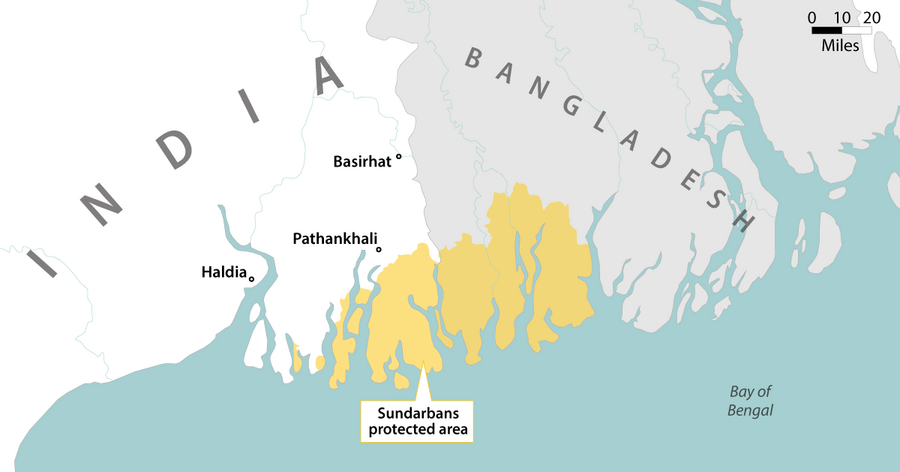
A trafficking survivor visits the office of Basirhat Initiative for Rural Dedication for counseling.

Human traffickers prey on desperate women in the vast, vulnerable Sundarbans region. The co-founder of a grassroots organization is fighting for women to reclaim their legal power.

Jacob Turcotte/Staff

A letter from

Yukon
Melanie Stetson Freeman/Staff
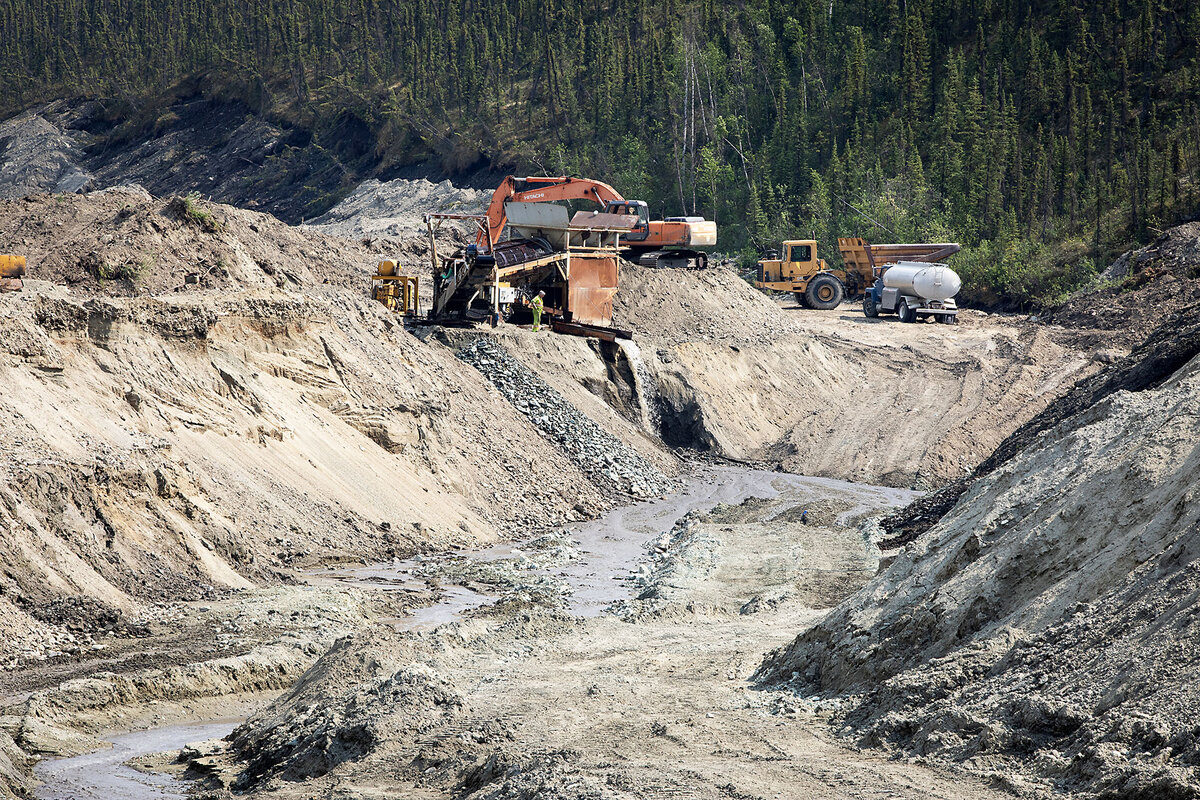
With 50 years of experience in placer mining, the Millar family runs the Goldbottom Mine in Hunker Creek, near Dawson City, Yukon, June 18, 2025.

The gold rush may be long over, but the work of extracting valuable minerals from stream deposits – modern “panning for gold” – still goes on in Canada’s Yukon. Today, it’s a family business, passed down from generation to generation.


The Monitor's View

AP
Syrians who fled their homes during the country's civil war gather to celebrate their return to Arbeen, Syria, Aug. 4.

Until last year, a country at the heart of the Middle East was known for enduring one of world’s largest population displacements. About half of Syria’s 23 million were forced to flee their homes during a 14-year civil war. Since the ouster of a dictator nine months ago, however, more than 2 million citizens have returned. Most go back to pick up old lives and recreate a democratic country.

“When we were expelled, it felt as if our souls had been torn from our bodies,” Mamdouh al-Sattouf, a former school principal, told Al Jazeera. “Now that we have returned, it feels as if we have regained our souls.”

The rising pace in the number of Syrian returnees is due in part to a new government’s efforts to hold elections this month, revive the economy with foreign help, and restore Syria’s former social harmony between diverse ethnic and religious groups.

“Most people will want to participate in the new Syria, provided the government respects their regional and local interests,” Birgit Schäbler, a historian of the region at Germany’s University of Erfurt, told Deutsche Welle.

In a recent visit to the country, a top United Nations official for refugees found many returnees were busy replanting family and community roots. “I saw up-close how people have preserved their will to return, stay and rebuild despite the harsh reality of destruction,” said Kelly Clements, Deputy High Commissioner of UNHCR.

Parts of Syria have recently seen extreme violence between groups, highlighting the ongoing task of the interim president, Ahmed al-Sharaa, to build trust with all Syrians. A parliamentary election scheduled for Sept. 15-20 will be a crucial test along with his efforts to bring justice for past atrocities and reconcile a torn society.

The president’s task has been made easier given the almost-daily convoys of vehicles bringing Syrians back to their hometowns. To many people in the Mideast, home is not just a place but a religious obligation of hospitality - a “generosity of spirit ... which defines humanity itself,” states Mona Siddiqui, professor of Islamic and Interreligious Studies at the University of Edinburgh.

Or, as one returnee, Mustafa al-Hajj, told Le Monde as he crossed the border from Lebanon: “It’s the first time I’ve entered my country with love in my heart.”


A Christian Science Perspective

About this feature

Each weekday, the Monitor includes one clearly labeled religious article offering spiritual insight on contemporary issues, including the news. The publication – in its various forms – is produced for anyone who cares about the progress of the human endeavor around the world and seeks news reported with compassion, intelligence, and an essentially constructive lens. For many, that caring has religious roots. For many, it does not. The Monitor has always embraced both audiences. The Monitor is owned by a church – The First Church of Christ, Scientist, in Boston – whose founder was concerned with both the state of the world and the quality of available news.

Recognizing everyone’s true nature as God’s spiritual offspring is a powerful starting point for progress.


Viewfinder

Marco Garcia/Reuters
World War II veterans Leon Silverman (l.) and Jack Stowe attend a ceremony to mark the 80th anniversary of Japan’s surrender, on the pier next to the USS Missouri in Honolulu, Sept. 2, 2025.
( The illustrations in today’s Monitor Daily are by Jacob Turcotte. )

More issues

2025
September
04
Thursday